

NDS2 signals a decisive shift from broad aspiration to targeted, results-driven national transformation. It tightens the focus on productivity, infrastructure renewal, and macroeconomic stability while deepening the “leave no one and no place behind” ethos that has defined the Second Republic’s development philosophy. What makes NDS2 significant is its insistence on measurable outcomes – stronger value chains, accelerated industrialisation, modernised public services, and expanded social protection – all anchored in a disciplined implementation framework. If executed with the same momentum seen in recent national projects, NDS2 has the potential to consolidate economic recovery and position Zimbabwe firmly on the path toward Vision 2030.

It is hardly surprising that Prof. Gift Mugano and the ZFN Friday Drinks panel, led by Tinashe Murapata, have once again stepped forward as self-appointed auditors of national progress. Their commentary has become predictable: whenever Government registers measurable achievements, they instinctively cast doubt before examining the underlying facts. Thus, when Treasury announced funding for dam construction, they immediately reached for a narrative of suspicion.
Their latest attempt to question the 2025 dam allocations collapses under even the most basic scrutiny. More …
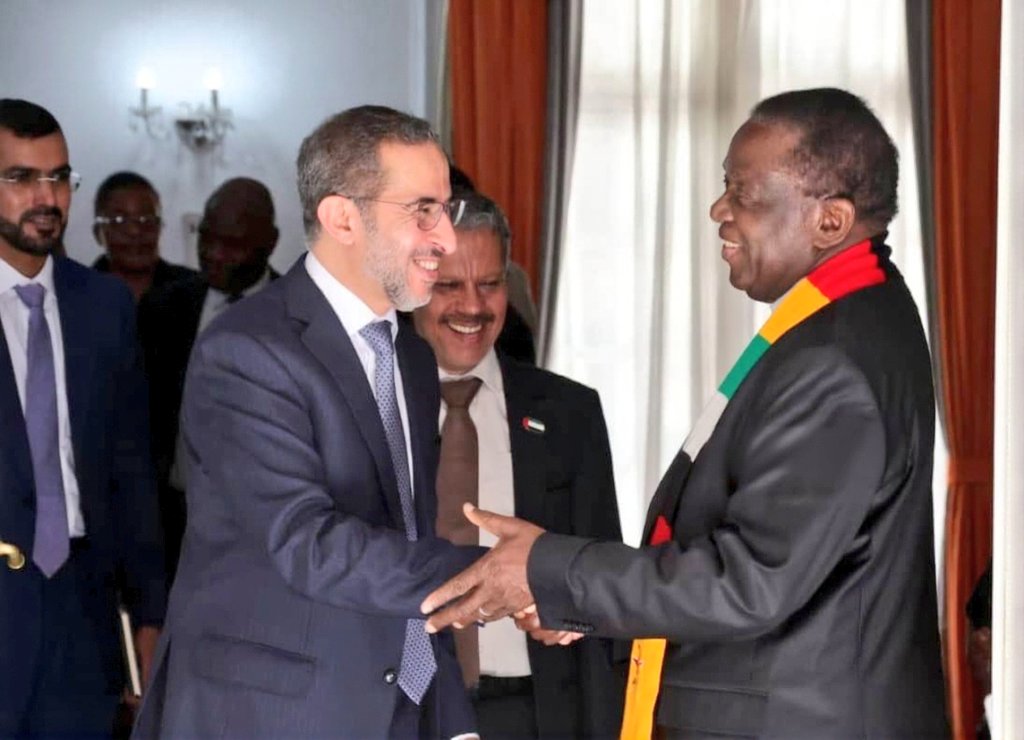
His Excellency President E.D Mnangagwa today met the Chief Executive of the Abu Dhabi National Oil Company, Mr Ahmed Bin Thalith, at State House, in yet another sign of the growing economic partnership between Zimbabwe and the United Arab Emirates. Mr Bin Thalith reaffirmed ADNOC’s interest in expanding its role in Zimbabwe’s fuel supply chain, emphasising the company’s readiness to help stabilise the market and support competitive pricing for retail consumers. He also conveyed appreciation for the strong diplomatic ties between Harare and Abu Dhabi, noting that this political goodwill has created a solid foundation for long-term cooperation.
The meeting reflects Zimbabwe’s broader strategy of deepening engagement with Gulf nations that have become important players in energy, mining, and logistics across the region. For Abu Dhabi, Zimbabwe offers a strategic gateway into Southern Africa, while for Harare, the partnership promises enhanced energy security and access to more competitive global supply networks.

Zimbabwe today entered a new chapter of its development trajectory with the official launch of the National Development Strategy 2 (NDS2), the five-year economic blueprint that will guide national priorities from 2026 to 2030. The programme builds directly on the gains achieved under the Transitional Stabilisation Programme and NDS1, positioning the country to accelerate its march toward Vision 2030.
Vice President Dr Constantino Chiwenga and the Minister of Finance, Economic Development and Investment Promotion, Professor Mthuli Ncube, arrived at State House early in the afternoon, joining Cabinet Ministers, senior Government officials and members of the diplomatic community for the highly anticipated event. President E.D. Mnangagwa later stepped in to formally open the proceedings, signalling the start of a critical policy cycle for Zimbabwe’s medium-term future. More …

Cdes, we must distinguish between two matters that are too often mixed up: xenophobia on one hand and legitimate national policy concerns on the other. The position articulated by the ZANUPF Conference, endorsed by Cabinet, and echoed by Cde Dr. Kudakwashe Tagwirei firmly belongs to the latter category and reflects long-standing economic realities that Zimbabwe can no longer ignore.
In developing economies, the reserved-sector principle exists to safeguard micro-enterprise spaces that support millions of citizens. When these sectors remain unregulated, predictable distortions follow. Informal monopolies take root, domestic entrepreneurs are squeezed out, and foreign-currency leakages intensify. Zimbabwe is experiencing all these pressures simultaneously. The situation in areas such as kwaGazaland, kuMbare, the CBD, and other high-density commercial corridors is a clear example. Foreign-owned micro-stores now dominate retail spaces traditionally occupied by Zimbabweans. Their presence is not inherently problematic – foreign capital is important – but when it expands into reserved or low-capital, high-volume sectors, the outcome is sharply negative for citizen livelihoods. This is a structural challenge, not a personal one. More …

About Me
Hi, I’m Dereck Goto. I use this space to think out loud about ideas, systems, power, and the quieter details that shape how we live and communicate. This blog isn’t about chasing trends or offering comfortable conclusions. It’s about asking better questions, challenging lazy narratives, and exploring issues with honesty and intellectual independence. Some posts are analytical, some reflective, and some deliberately provocative - but all are written with intention.