Why Copper Queen Matters Again

Growing up in areas bordering Midlands and Mashonaland West, one name always stood out to me in Gokwe North – Copper Queen. To my young mind, it felt like an oddity. An unmistakably English name sitting in a landscape rich with powerful Shona place names – Nembudziya, Gandavaroyi, Gandavacheche, Mudzongwe, Tiki, Madzivazvido, Chinyenyetu, Kuwirirana. These names carried texture, history, and meaning. Copper Queen felt different – foreign, curious, intriguing.

What I did not understand then was that Copper Queen was already more than a mine. It had crossed an invisible line – from extraction point to lived geography. The name did not remain confined to a shaft or a claim. It became a reference point, a farming area, a way people located themselves. Nearby, there was also Copper King, another copper site in the same mineralised zone. But Copper King never made that transition. It remained a technical marker – present in records and reports, but largely absent from everyday belonging. More …

Chamisa’s Ritual of Failure – ZANUPF’s Enduring Insurance Policy

Nelson Chamisa’s latest re-emergence is not a comeback but a ritual repetition. His interview with the South African Broadcasting Corporation merely reaffirmed what has long been evident to serious observers of Zimbabwean politics. He speaks fluently of “structures, systems, and institutions” while embodying their negation. Across every political formation he has led, Chamisa has governed by personal decree rather than constitutional process. These movements did not collapse solely due to external pressure; they disintegrated because authority was never delegated, never contested, and never renewed.

The consequence has been a lost decade of opposition development. This is not because Zimbabwe lacks intellectual or organisational talent, but because that talent has been systematically expelled, discouraged, or rendered redundant. After each electoral cycle, the same choreography unfolds – purges, abrupt dissolutions, and ideological resets marketed as “renewal.” In practice, these episodes function as rolling institutional amnesia. Lawyers, economists, organisers, diplomats, and administrators – those capable of building durable political machinery – are either marginalised or pushed out entirely. Chamisa does not merely inherit institutional weakness; he reproduces it, ensuring that every cycle begins poorer in experience than the last.
More …

Disinformation by Design – Targeting the CIO’s Institutional Stability

The online article by ZimEye attacking the Director-General of the Central Intelligence Organisation, Dr Fulton Mangwanya, is better understood not as journalism but as narrative construction presented in the guise of reporting. While rich in conjecture, it is devoid of empirically verifiable content. Its internal qualifiers are revealing: reliance on unnamed sources, unsubstantiated allegations, and explicit acknowledgements that claims cannot be independently verified. In analytical terms, such material does not constitute evidence; it functions as an influence artifact – a text designed to shape perception rather than establish fact.

The choice of target is instructive. Effective intelligence institutions are seldom challenged through demonstrable facts; they are more often subjected to insinuation. Anonymous allegations are a standard instrument when adversaries lack access, proof, or operational leverage. The objective is not exposure but attrition – the gradual erosion of public confidence through repetition and manufactured doubt. This method is well documented within information warfare, particularly against states that have consolidated their security architectures. More …

Liberation-Era Bonds Still Shape China–Zimbabwe Cooperation, Says Zhou Ding

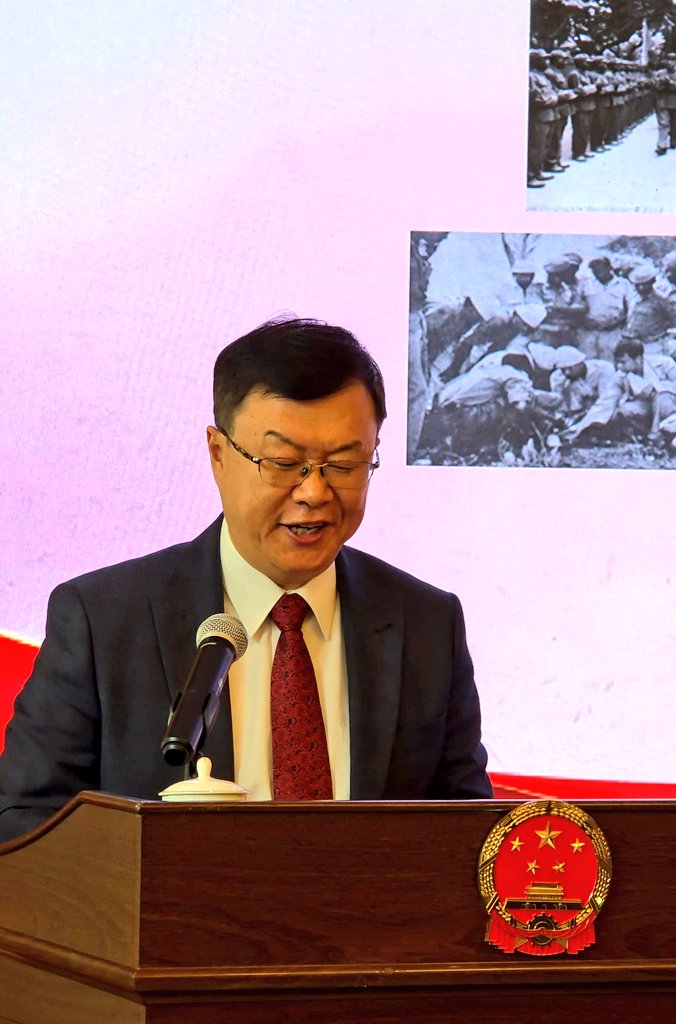
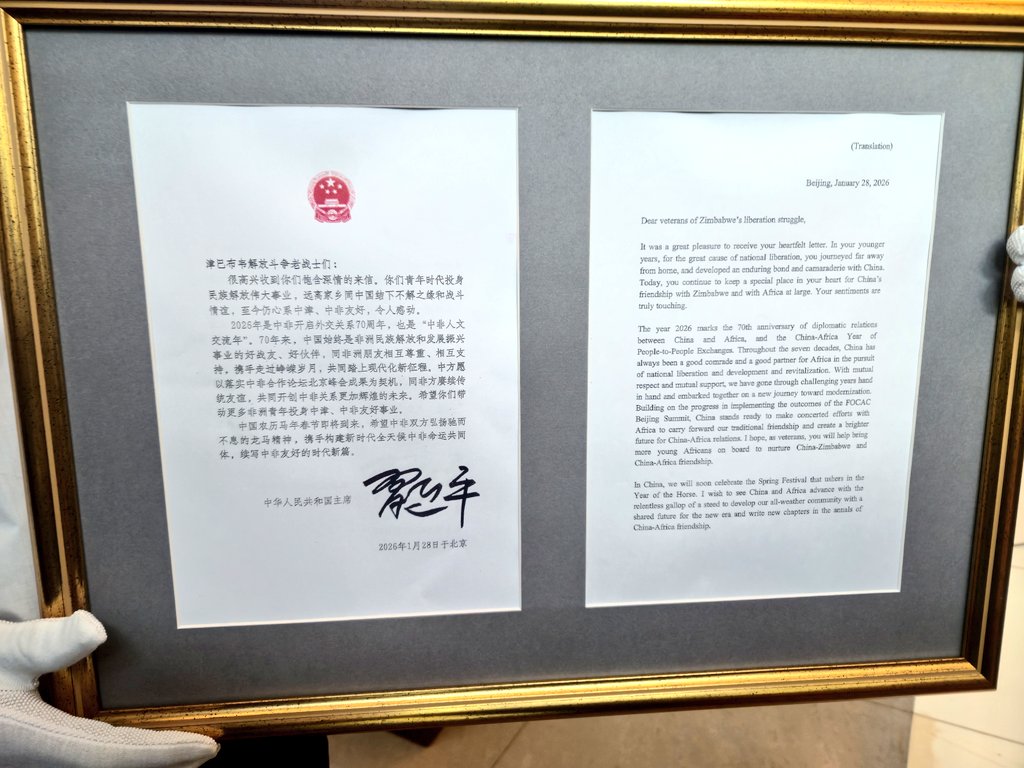
Chinese Ambassador to Zimbabwe, Zhou Ding, on Tuesday handed over a reply letter from Chinese President Xi Jinping to Zimbabwean liberation war veterans, reaffirming the long-standing friendship between the two countries that dates back to the liberation struggle.

Speaking at the Chinese Embassy in Harare, Ambassador Zhou said the letter followed a joint message written by 17 Zimbabwean war veterans who had received military training in China or in Chinese-supported camps in Tanzania during the liberation war. The veterans had written to President Xi recalling their training experiences, thanking China for its support during Zimbabwe’s struggle for independence, and expressing commitment to strengthening China–Zimbabwe relations. More …

Letter from President Xi Jinping to Zimbabwe’s Liberation War Veterans

(TRANSLATION)

Beijing, January 28, 2026

Dear veterans of Zimbabwe’s liberation struggle,

It was a great pleasure to receive your heartfelt letter. In your younger years, for the great cause of national liberation, you journeyed far away from home, and developed an enduring bond and comradeship with China. Today, you continue to keep a special place in your heart for China’s friendship with Zimbabwe and with Africa at large. Your sentiments are truly touching. More …

Chamisa: An Opposition Engineered to Lose

Let us be candid, without false modesty: somewhere in the quieter corners of power, Chamisa is spoken of with a mix of amusement and appreciation because he reliably relieves pressure off the state. For a ruling party focused on execution, continuity, and long-term planning, his style of politics has become an unexpected advantage – a gift that renews itself every electoral cycle.

While President Mnangagwa’s administration is absorbed in the hard work of dam construction, road rehabilitation, power generation, agricultural recovery, and industrial revival, Chamisa is busy running what can only be described as a longform psychological experiment. He has elevated “strategic ambiguity” into an art form, mistaking the absence of policy for flexibility, and confusion for depth. In practice, it amounts to having no plan at all, delivered with confidence. More …

The “Madhuku Strategy” 2.0: Nelson Chamisa and the Art of Perpetual Becoming

The comparison between Nelson Chamisa and Lovemore Madhuku has shifted from a basic analogy to an analytical necessity. What the late President Robert Mugabe once derisively labelled the “Madhuku strategy” – a pattern of opportunistic activism designed to trigger international headlines and donor funding – has found a contemporary heir. Both figures embody a political model defined less by institution-building than by episodic mobilisation and the systematic monetisation of hope.

Chamisa’s political trajectory has descended into a repetitive cycle of strategic ambiguity that looks less like a path to political victory and more like a sophisticated fundraising circuit. By abandoning established structures for a series of ephemeral brands – moving from the MDC-Alliance to the Citizens Coalition for Change (CCC), and now to a nebulous, structureless movement – Chamisa has perfected the art of the political “rebrand” as a means of bypassing accountability. Much like Madhuku, who morphed the National Constitutional Assembly from a civic platform into a personal political vehicle, Chamisa’s solo-preneurship treats the Zimbabwean electorate as a captive market rather than a constituency.
More …

Performance Legitimacy and the 2030 Mandate

Performance legitimacy – the validation of political authority through tangible socio-economic outcomes – offers a clear framework for understanding the growing momentum within ZANUPF provinces to extend President Emmerson Mnangagwa’s tenure to 2030. Rather than a procedural manoeuvre, this push reflects a judgement that continuity best serves Zimbabwe’s current developmental trajectory. More …

ZANU PF Suspends Distribution of Presidential Economic Empowerment Revolving Fund

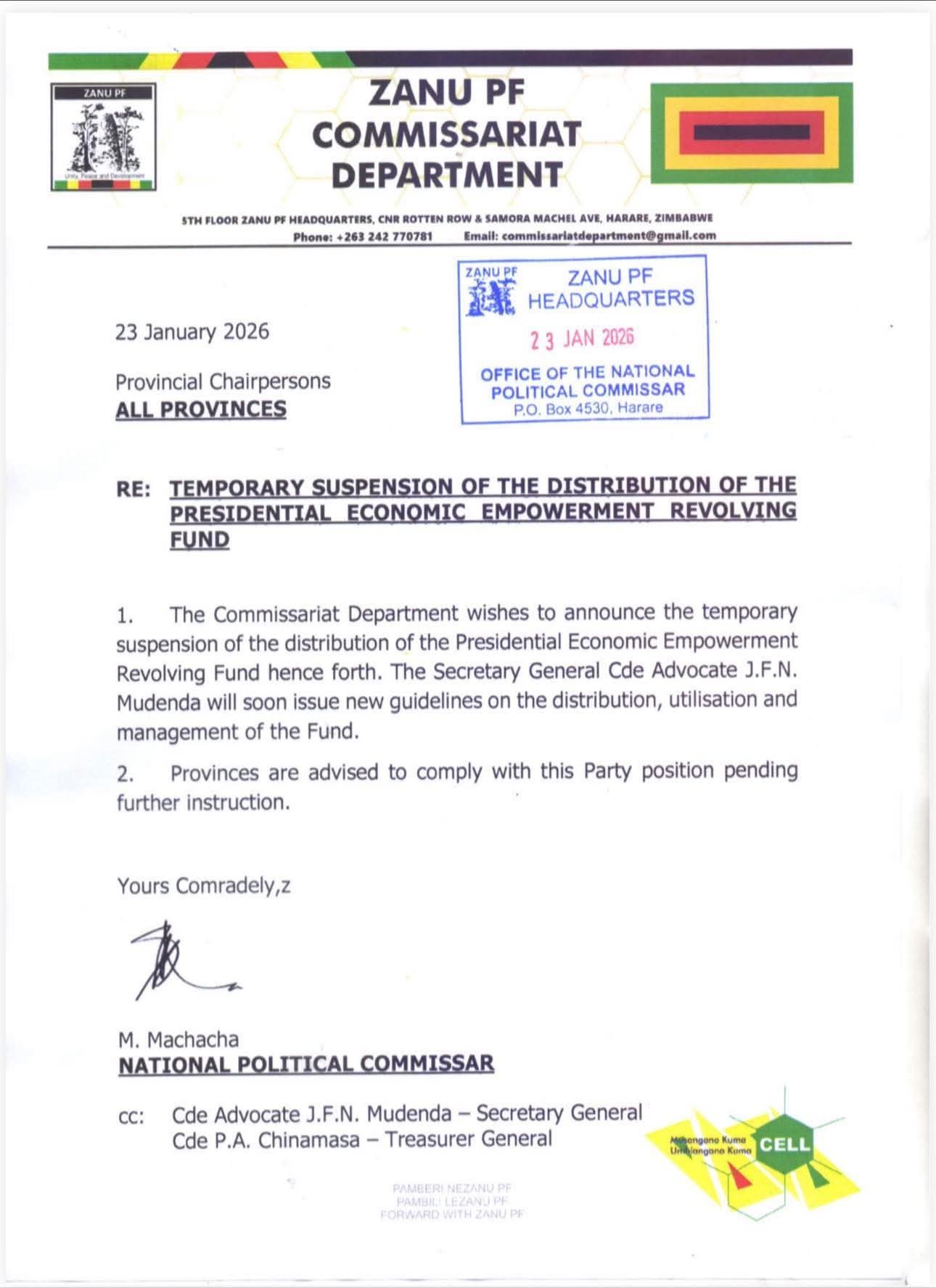
The ZANU PF Commissariat Department has announced the temporary suspension of the distribution of the Presidential Economic Empowerment Revolving Fund, with immediate effect.

In a circular dated January 23, 2026, addressed to provincial chairpersons across all provinces, the party said the suspension will remain in force pending the issuance of new guidelines governing the fund’s distribution, utilisation, and management.
More …

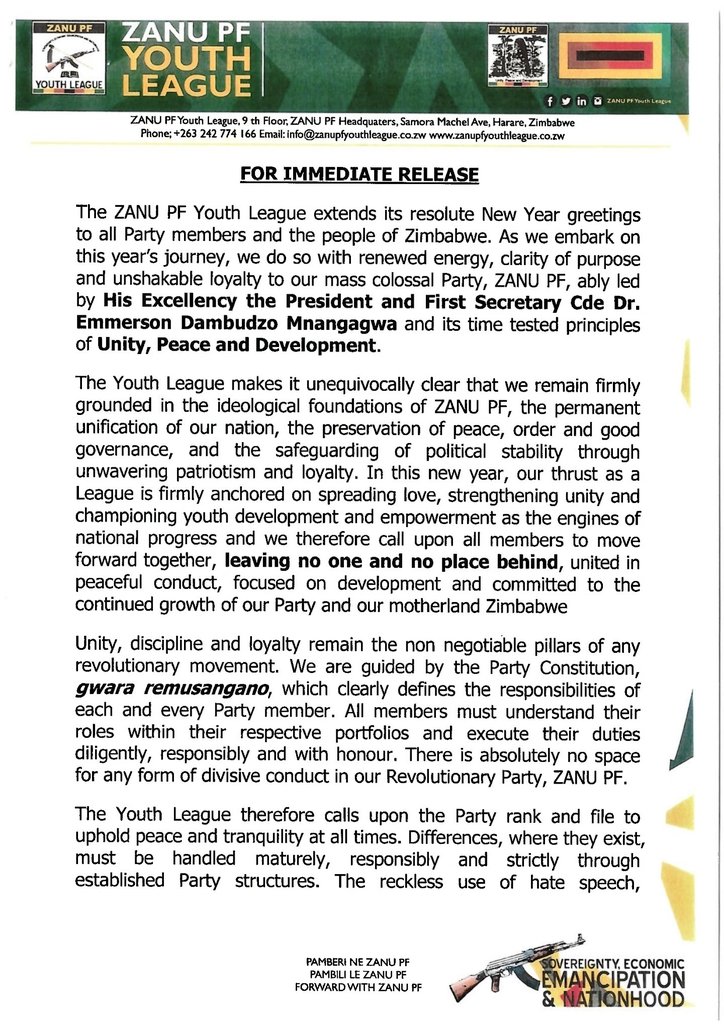
ZANUPF Youth Demand A Return to Gwara Remusangano

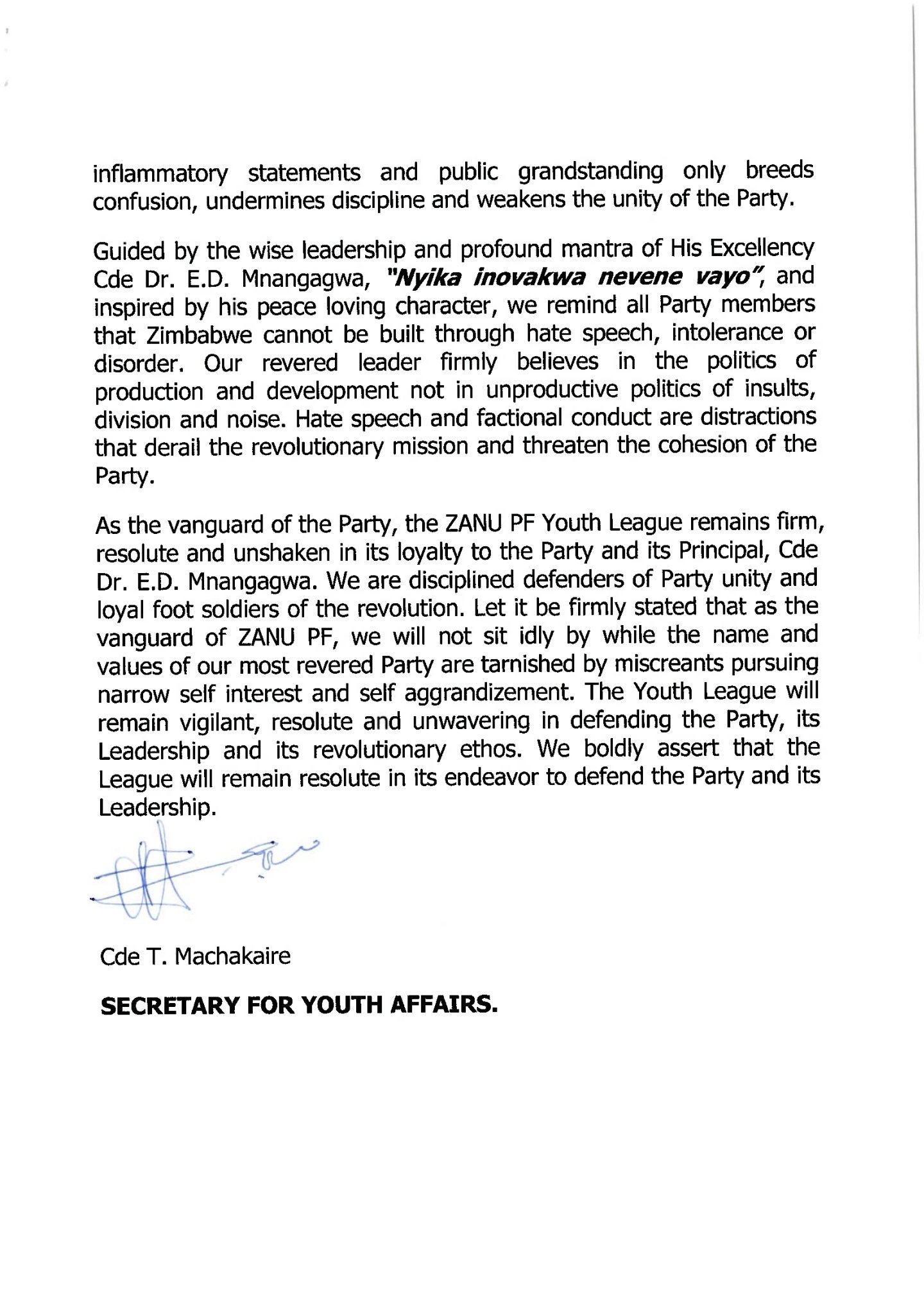
The ZANU PF Youth League’s latest statement, delivered under the stewardship of Tinoda Machakaire, is less a ceremonial New Year greeting than a calibrated intervention into a moment of visible internal strain. Against the backdrop of public spats, social media outbursts, and factional signalling, the communiqué reads as a corrective memo to cadres who have mistaken visibility for authority and noise for influence. More …