In the Age of Artificial Intelligence – Secure the Land, Secure the Claims

There are few Zimbabweans better placed to comment on technological disruption than Trevor Ncube. So when he speaks about the sweeping impact artificial intelligence will have across economic sectors, it is worth listening. He witnessed, in real time and in public, how the digital revolution dismantled the traditional news business model that had sustained media houses for decades. Classifieds migrated online. Advertising fragmented. Attention atomised. News became instant, abundant and algorithmically distributed. If anyone understands how swiftly technology can erode once-stable professions, it is him. And on one central point, he is absolutely correct: knowledge-work is exposed, and denial is fatal.

But Zimbabwe’s larger story goes even deeper. Artificial intelligence will not simply disrupt services; it will reorganise the real economy itself. It will not stop at lawyers, bankers, accountants or property agents. It will reach creatives, coders, farmers, miners, logistics operators and even the AI industry itself. This is not a sectoral tremor. It is a structural shift.
More …

Aid with Conditions – Why Zimbabwe Chose Principle Over $350 Million

Zimbabwe recently rejected a proposed US$350 million health funding agreement with the United States after President Emmerson Mnangagwa directed his government to halt negotiations. The deal, presented under Washington’s America First Global Health Strategy, was intended to shape future US health support to Zimbabwe. However, Harare concluded that its conditions were incompatible with national sovereignty.

Two elements reportedly raised serious concern. First, the agreement sought direct access to Zimbabwe’s health data for a defined period – something officials viewed as excessive and potentially intrusive. Second, the US reportedly pushed for access to Zimbabwe’s critical mineral resources within the broader framework of the arrangement. In addition, Zimbabwe objected on principle to entering a bilateral health architecture with a country that had withdrawn from the World Health Organisation, arguing that such a move would weaken multilateral global health governance. More …

Zimbabwe Must Not Blink: Mutapa Investment Fund Must Lock Down Tongaat Hulett’s Lowveld Assets

I recently read Munyaradzi Hoto’s analysis on X about the demise of Tongaat Hulett. It sent me down a rabbit hole of court filings, business reports, creditor positioning, and the kind of corporate manoeuvring that could easily produce a blockbuster documentary. Yet for all the South Africa-centred drama, the most sobering realisation came later: Tongaat Hulett’s Zimbabwe operation in the Lowveld is not a minor subsidiary caught in someone else’s storm. It is a major node in the entire matrix. And once you see that, it becomes difficult to avoid the obvious conclusion – our government must ensure this asset becomes Zimbabwean-controlled going forward, through a lawful, market-based transaction anchored by Mutapa Investment Fund. More …

Hysteria is Not the Defence of Constitutionalism

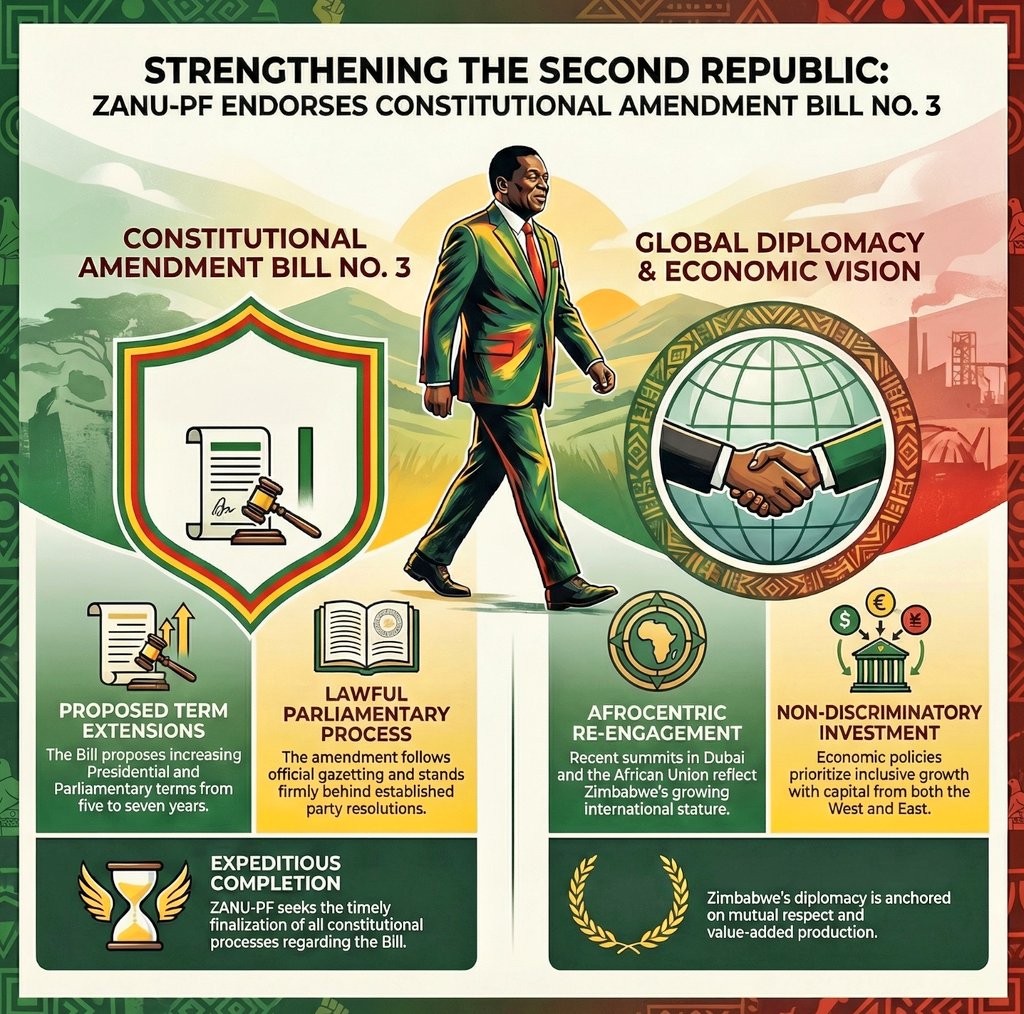
The escalating hysteria over Constitutional Amendment No. 3 of 2026, particularly within opposition circles, exposes not a crisis in the Constitution, but a crisis in collective political maturity and constitutional literacy. A constitution is not a relic preserved behind glass; it is a governing instrument built to operate in the present. It exists to organise power, correct defects and respond to changing realities. Amendment, in itself, is neither betrayal nor taboo – it is part of constitutional design.

What is troubling is not opposition, but the drift toward confrontation. Incitement to violence is not democratic engagement; it is a crime. Citizens have every right to reject a proposal. But when political actors begin invoking “physical action” and mass mobilisation in tones that hint at disruption, the conversation shifts from reasoned disagreement to calculated instability. More …

Africa hails Xi’s AU message for joint pursuit of modernization, Global South solidarity


[RE-POST (Xinhua)]

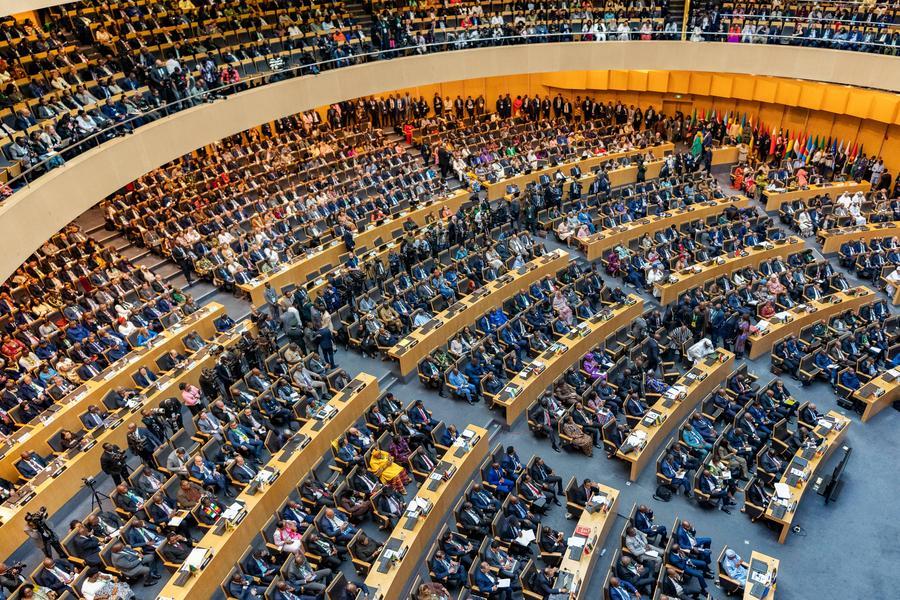
Chinese President Xi Jinping’s congratulatory message to the 39th African Union (AU) Summit held in Ethiopia is believed to demonstrate China’s firm support for Africa’s independent development.

In his message, Xi announced that China will fully implement zero-tariff treatment for 53 African countries having diplomatic relations with China starting from May 1, 2026. He also highlighted efforts to upgrade the “green channel” for African exports. More …

Zimbabwe Must Draw the Line on Minors Online

Childhood is not a beta test. Yet we have allowed it to become one – at scale, in public, and for profit.

In Britain, Sir Keir Starmer’s government has now drawn a line, insisting that “no platform gets a free pass” as it moves to close loopholes that allow illegal and harmful material – including AI-generated content – to circulate and target children. The direction of travel is unmistakable: the era of self-regulation, polite warnings, and parent-blaming is ending. More …

Are Young Nations Paying an Invisible Instability Tax?

Zimbabwe’s current electoral system may be imposing a self-induced instability tax the nation can ill-afford.

What if recurring five-year electoral cycles – combined with high-stakes presidential contests – quietly embed structural volatility into a country that most needs continuity?
What if the greatest obstacle to development in young nations is not corruption, ideology, or capacity – but time?

Elections are treated as sacred rituals. Yet should democracy be measured by the frequency of political combat – or by the durability of national progress? More …

Constitution, Time, Development: Zimbabwe’s Defining Equation

There are moments in a nation’s life when the argument is not chiefly about personalities, slogans, or the theatre of the day – but about time itself: how it is organised, how it is protected, and how it is converted into national capability. Constitutional Amendment No. 3 of 2026 belongs in that register. It is best read not as a narrow political adjustment, but as an attempt to redefine how Zimbabwe structures constitutional time in pursuit of stability, coherence, and developmental momentum.

Modern constitutional democracies often treat elections as sacred civic rituals – an unquestioned rhythm that promises renewal, accountability, and legitimacy. The five-year cycle, in particular, has become an inherited orthodoxy, largely drawn from Western parliamentary traditions, and carried across borders as though it were a universal formula. Yet a sobering question lingers beneath the ceremony: does the tempo of frequent elections reliably deepen development, or can it – in certain institutional environments – fracture it into permanent motion without durable progress? More …