When Curiosity Outruns Reality

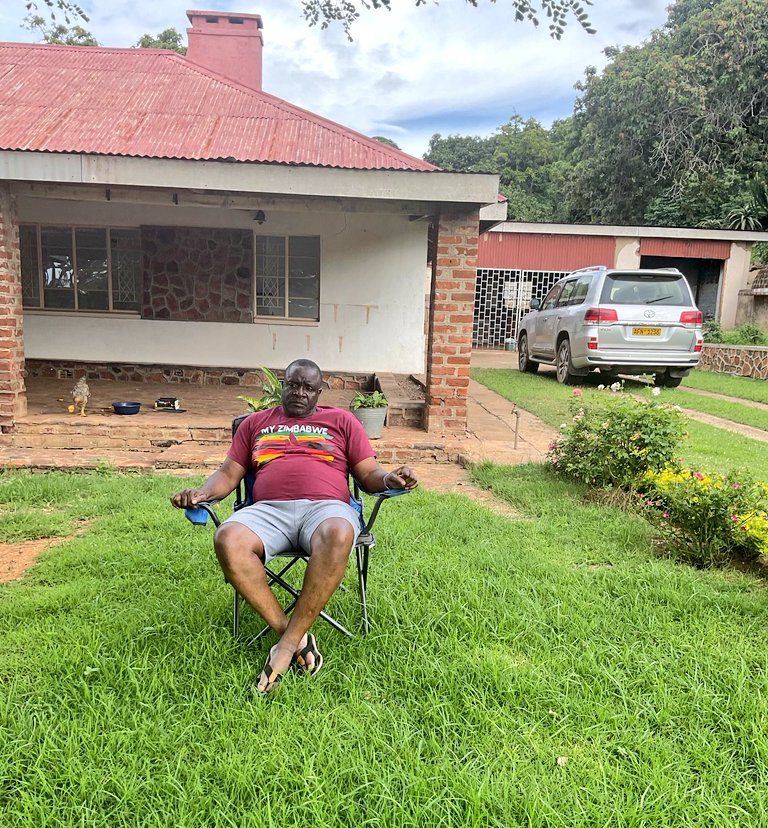
As someone deeply interested in mass communication and how public thinking is shaped, I found the reaction to Cde George Charamba’s attached photo fascinating. I know the place well. I have visited the site in Mashonaland West, near its border with Mashonaland Central – a beautiful setting with a perennial stream running through it and a mountain at one end – and I am familiar with how the property was acquired, its intended purpose, and the wider context of the surrounding properties.

With that background, the comment section was both hilarious and revealing. A simple image quickly triggered speculation, assumptions, and elaborate stories, most of them imagined. What should have remained ordinary was transformed into drama, driven by the urge to fill informational gaps with confident conclusions. More …

Making Land Bankable

Zimbabwe’s decision to decentralise land title deed processing to the provinces is a long-overdue reform with the potential to fundamentally reset the country’s agricultural economy. By bringing land administration closer to farmers, the Government is not only reducing bureaucracy and delays, but also addressing the central constraint that has limited post-land reform productivity: insecure and non-bankable tenure. This is devolution with substance, not slogans. More …

The Delusions of a Defector

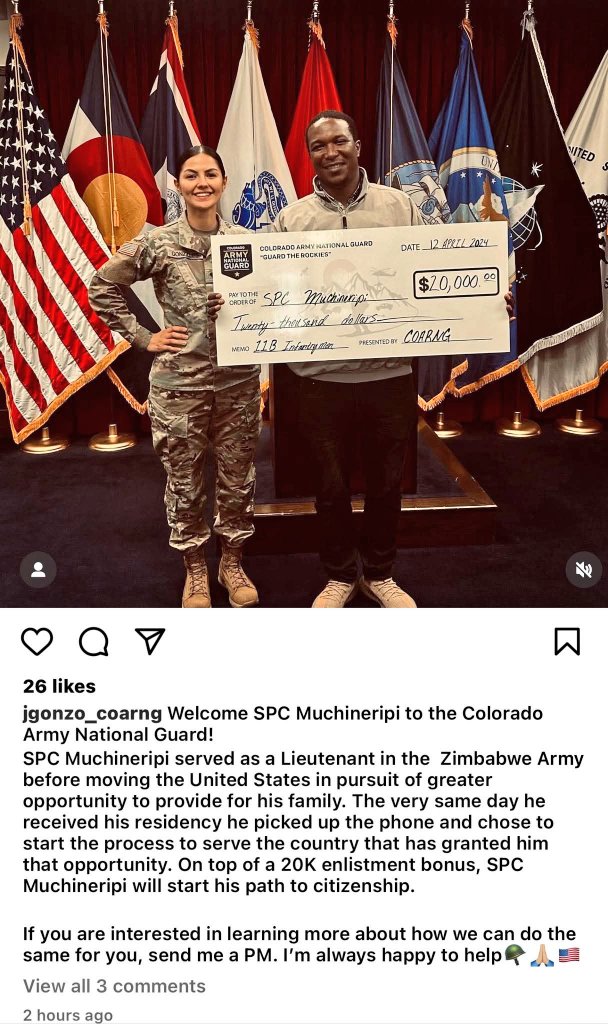
The latest attempt by American interests to smear Zimbabwe’s sovereignty relies on a particularly weak vessel: Kelvin Muchineripi. This self-styled “whistleblower” – now conveniently drawing a paycheck from the US Army National Guard – has surfaced with absurd, evidentiary-free allegations that the Zimbabwe Defence Forces rigged recent elections. However, these claims crumble under the slightest logical scrutiny. More …

The Youth Engine Behind China’s Rise – And the Lessons We Should Not Miss

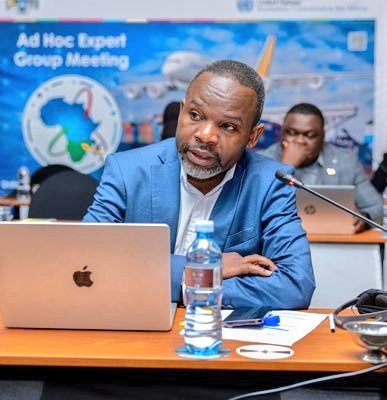
There are moments when a nation’s grand strategy reveals itself in an ordinary room, through ordinary competence. I recently attended a seminar that brought together heads of key media from Belt and Road countries. The agenda was serious, the participants were senior, and the expectations were high. Yet what stood out was not protocol, microphones, or banners. It was the coordination.

The event was run by multiple young Chinese nationals – highly educated, openly aspirational, and strikingly composed. They handled logistics, sequencing, time discipline, and stakeholder management with an efficiency that required minimal supervision. The confidence was not loud. It was structured. The competence was not performative. It was practical. In that small, human scene, one could glimpse a larger truth: China’s international stature is not sustained only by policy documents and speeches. It is sustained by a deep pipeline of capable young people who execute.
More …

Zimbabwe Is No Longer Guessing

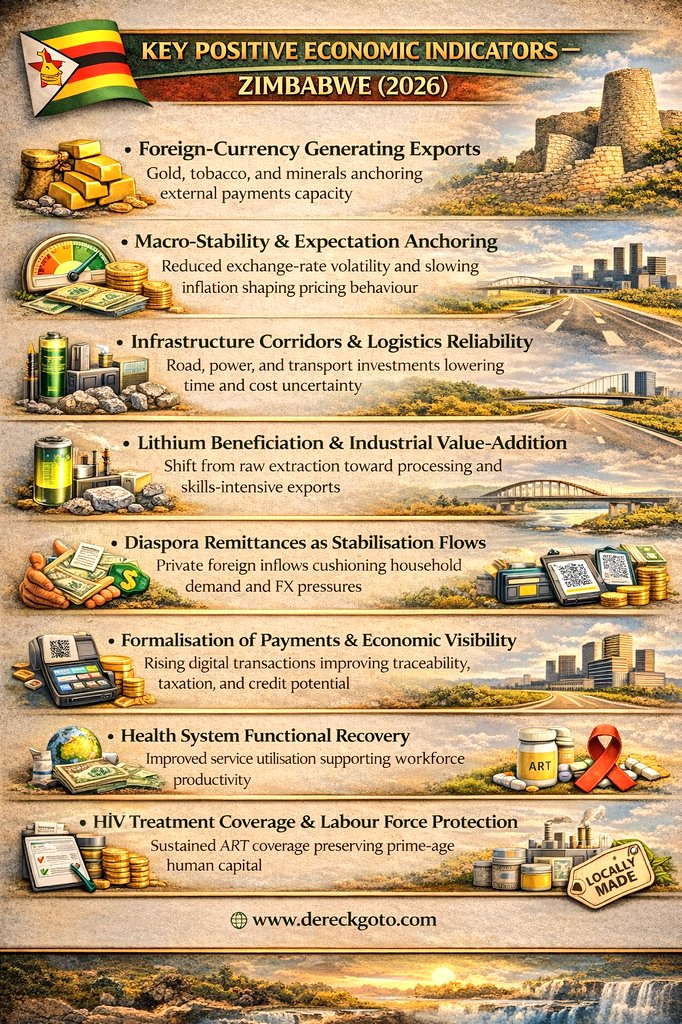
As the sun rises on 2026, Zimbabwe stands at a vantage point that few observers predicted a decade ago. The country is no longer merely recovering, no longer suspended in a narrative of exception or apology. What is emerging instead is a state learning in public, adjusting in motion, and ascending with an unusual mix of restraint and confidence. The launch of the National Development Strategy 2 is not a bureaucratic sequel to NDS1, but the codification of a distinct model of statecraft and economic resilience that future scholars may well describe as a Zimbabwean or Harare-centred consensus.

To understand where Zimbabwe is going, one must first appreciate the architectural feat of the last five years. NDS1 was never designed to inspire romance. It was the era of the hard hat rather than the headline, a stabilisation phase defined by concrete, discipline, and endurance. It was a period of fixing fiscal leaks, rebuilding arterial roads, restoring agricultural self-sufficiency, and proving to a sceptical world that the Zimbabwean state could still plan, execute, and feed its people under pressure. In political terms, it was a defensive masterclass – holding the line against sanctions, pandemic shocks, and capital starvation while quietly reconstructing domestic capacity. NDS1 functioned less as a development manifesto than as a stabilisation engine disguised as one. More …

The Rules Are for You, Not for the USA

The mask has finally fallen. Yesterday’s brazen kidnapping of the Venezuelan President by the USA is not merely a violation of law; it is the resurrection of the colonial mandate. In seizing a sitting Head of State and declaring, as President Trump did yesterday, that the US will now “run the country” to ensure “American dominance in the Western Hemisphere,” Washington has stripped away the polite fiction of “democracy promotion.” This is 19th-century imperialism with 21st-century technology. It is, as Venezuelan Foreign Minister Yvan Gil correctly identified, a “colonial war” designed not to liberate a people, but to seize “strategic resources, particularly vast oil reserves.”

The Global South has been disciplined for generations to believe in a neutral order – one where law restrains power. That belief now collapses under the weight of evidence. More …

America’s Imperial Decline in Real Time

America’s action against Venezuela is being sold as strength, resolve, and leadership. In truth, it is something far less flattering. It is fear, stripped of discipline and dressed up as authority. Fear of a world that no longer waits for Washington’s permission. Fear of systems that function beyond the dollar. Fear of governments that refuse to be disciplined by sanctions or intimidated by threats. Fear, above all, of irrelevance.

Empires at ease do not behave this way. Confident powers do not lurch from economic strangulation to open coercion. They do not normalise the language of seizure and removal when persuasion fails. They do not need to turn a sovereign state into a public spectacle to remind others who is in charge. These are the reflexes of a hegemon sensing that the ground beneath it is shifting. More …

The Fault Lines of Zimbabwe’s Liberation Struggle

I have been closely following a compelling oral-history series on Zimbabwe’s War of Liberation (the Second Chimurenga), hosted by Robert Tapfumaneyi on ZimNews Beat TV’s YouTube channel ( https://youtube.com/playlist?list=PLBQumZCiCU8r2TUrcCvY3jBuw8xuMnYJY ). What initially appears to be a collection of veteran testimonies gradually unfolds into something far more unsettling and intellectually demanding: a mirror held up not only to the liberation struggle itself, but to how the nation has chosen to remember, narrate, and politically curate that struggle.

A striking and recurring theme in these interviews is the sharp distinction veterans draw between the nationalists – the political leadership – and the fighters – the men and women who carried the war on their backs, in forests, camps, and battlefields. Interview after interview reveals a persistent sense of dislocation: a gulf between what was imagined, promised, or morally implied by the liberation struggle and the lived realities many war veterans inhabit today. Hardly an episode goes by without an interviewee breaking down in tears on camera. This raises a difficult but unavoidable question: when a liberation war ends, whose victory is it meant to be? And how long can a revolutionary promise survive if those who bore its greatest cost feel estranged from its outcomes? More …

Brigadier General (Rtd) Mathias Tizirai Ngarava Buried

Born on 27 March 1959 in Mhokore Village under Chief Gororo in Chivi District, Masvingo Province, Brigadier General (Rtd) Mathias Tizirai Ngarava – known during the liberation struggle as Cde Elias Chimurenga – began his formal education at Shindi Primary School in 1967, completing it in 1974, before proceeding to Berejena Mission for his secondary studies in 1975.

His commitment to the liberation cause took a decisive turn in December 1976 when he left Rhodesia for Mozambique as part of a group tasked with securing ammunition. The journey was fraught with danger, cutting through the hostile terrain of Gonarezhou Game Park under constant surveillance and the ever-present threat of wild animals. Moving mainly at night and on foot, the group endured hunger, exhaustion, and the risk of detection. After reaching Mozambique, he was placed at Chibawawa Refugee Camp, where, in 1977, rigorous discipline, political orientation, and ideological training deepened his resolve to fully participate in the armed struggle. More …