
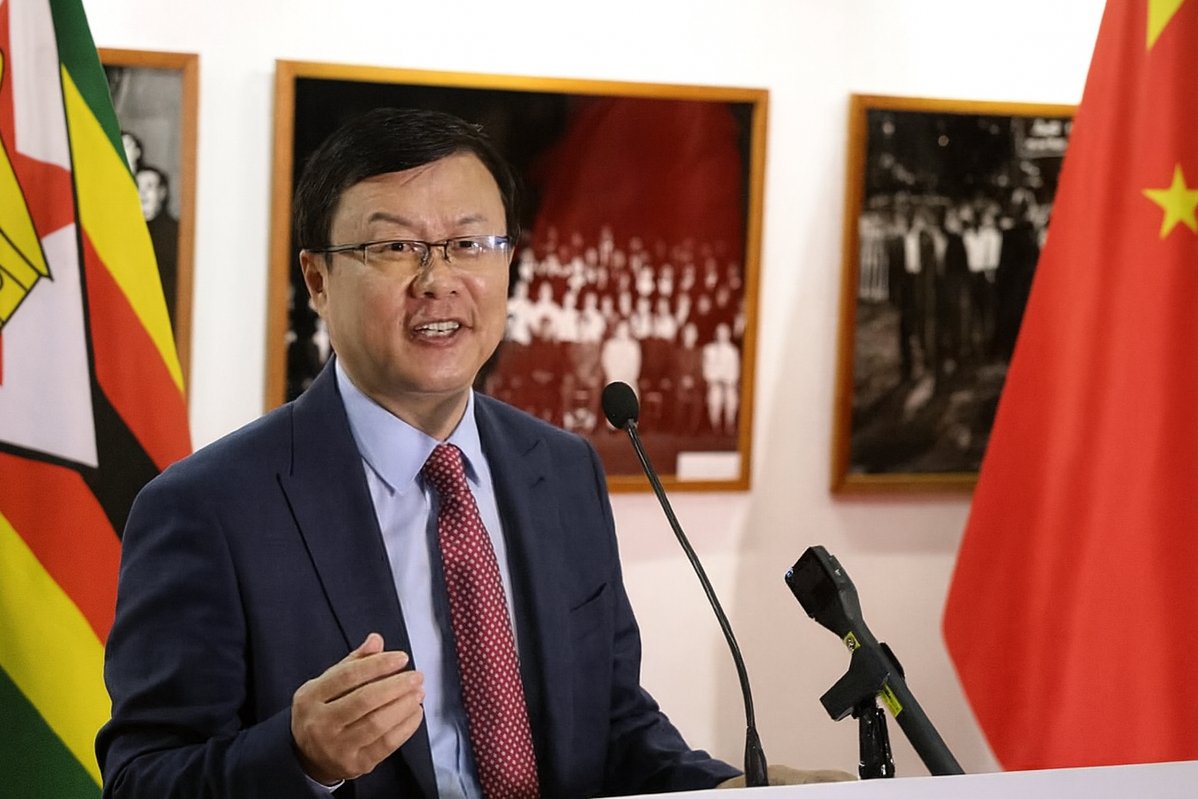
Harare witnessed something profound today – November 20, 2025 – something far deeper than diplomatic niceties or protocol speeches. When Chinese Ambassador H.E. Zhou Ding and Hon. Kudakwashe Mupamhanga addressed the China-Zimbabwe dialogue on aligning the 15th Five-Year Plan with Vision 2030, it became clear that Zimbabwe is no longer merely participating in global affairs. Zimbabwe is shaping its future with precision, clarity, and boldness under the revolutionary guidance of ZANUPF and the transformative leadership of President Dr. Emmerson Dambudzo Mnangagwa.
What unfolded was not a seminar, but a political and developmental alignment of two nations whose destinies have become intertwined by shared values – sovereignty, resilience, long-range planning, and people-centred development. While many nations wobble under the weight of political inconsistency and ideological drift, China and Zimbabwe are proving that nations rooted in liberation ethos and disciplined statecraft can chart their own course and prosper.
Ambassador Zhou Ding delivered one of the most intellectually forthright and ideologically grounded speeches China has ever presented in Harare. He outlined a China that is not retreating, not hesitating, not apologising – but boldly restructuring global power dynamics through strategic planning, technological dominance, and social stability. His message was unmistakable: China is entering a new epoch of development, and Zimbabwe is not merely invited to be a spectator – it is invited to be a partner, a beneficiary, and a collaborator.
For Zimbabwe, this could not come at a more opportune time. ZANUPF’s Vision 2030 and the soon-to-be-launched National Development Strategy 2 have already laid the ideological and structural foundation for a modern, industrialised economy. The Second Republic has dismantled bureaucratic red tape, unlocked investment corridors, stabilised governance systems, and accelerated infrastructure renewal. Ambassador Zhou’s words affirmed what Zimbabweans already know: under President Mnangagwa, Zimbabwe is open for business in the truest, most disciplined sense.
The numbers the Ambassador shared tell a story that no critic can ignore. Bilateral trade surging to USD 3.8 billion. Over 1,400 Chinese enterprises registered since 2022. Investments exceeding USD 10 billion. One million Zimbabweans directly or indirectly supported by Chinese-linked ventures. Tobacco exports that sustain half a million families. Solar farms ready to add 1,000 megawatts to our grid. Digital infrastructure that positions Zimbabwe to leapfrog outdated systems and plug directly into the Fourth Industrial Revolution.
This is not charity. This is partnership. This is strategic cooperation. And this is exactly what ZANUPF envisioned when it declared that Zimbabwe must industrialise, modernise, and engage.
Hon. Mupamhanga captured this sentiment perfectly when he spoke of youth empowerment – not as a vague aspiration but as the beating heart of national transformation. China’s scholarships, vocational exchanges, and capacity-building programmes are rapidly creating a generation of Zimbabweans who are confident, skilled, globally literate, and technologically competent. These youth are not the future – they are the present, ready to take their positions in agriculture, mining, ICT, manufacturing, and creative industries.
And the new zero-tariff access to the Chinese market? That is an economic earthquake waiting to reshape Zimbabwean exports. For decades, Zimbabwe dreamt of markets free from punitive restrictions and exploitative global conditions. Today, China has thrown open a door wide enough for Zimbabwean agriculture, textiles, manufacturing, and processed goods to flow unhindered into a market of 1.4 billion consumers. No Western lecture. No hidden conditionalities. No political interference. Just trade, opportunity, and respect.
But perhaps the most important moment of the Ambassador’s address was his candid rejection of misinformation. He spoke with clarity, insisting that Zimbabwe must protect its investment climate from malicious narratives designed to derail progress. This is a point ZANU PF has made time and again: no country advances when its development partners are attacked by sensationalism and political propaganda. Ambassador Zhou’s reminder that Chinese companies must follow Zimbabwean law – and that Zimbabwe must offer a predictable business environment – was a mark of mutual respect. It is a far cry from the hectoring tone Zimbabwe receives from Western capitals.
President Mnangagwa’s own words, quoted by the Ambassador – “No investment should be hindered by bureaucratic red tape” – embodied the Second Republic’s philosophy: growth must be deliberate, disciplined, and duty-driven. This is the President’s legacy. This is ZANUPF’s legacy. And this is the foundation of Zimbabwe’s modernisation.
What emerged from the seminar was a clear truth: Zimbabwe is aligning itself not with the declining powers of yesterday but with the rising forces of tomorrow. With China’s 15th Five-Year Plan synchronised with Vision 2030 and NDS2, Zimbabwe is positioning itself for accelerated industrialisation, robust agricultural modernization, technological leapfrogging, and sustainable energy independence.
The world is entering a new multipolar era, and Zimbabwe – once written off by outsiders – is now stepping confidently into its role as a strategic African player. Not by chance, not by luck, but by the deliberate, visionary leadership of ZANUPF and the enduring friendship with the People’s Republic of China.
The message of the day was unmistakable: Zimbabwe is rising. China is rising. And together, under the banner of an “All-Weather Community with a Shared Future”, they are rewriting the script of global development – one partnership, one investment, and one milestone at a time.
This is the Second Republic in motion.
This is Vision 2030 advancing.
This is the future, unfolding in real time.
A future built not on rhetoric, but on results.
Not on dependency, but on solidarity.
Not on borrowed ideologies, but on shared destiny.
And Zimbabwe is ready.

















































Post a comment