Remembering Cde Tongo

Today we remember Josiah Magama Tongogara, who died on 26 December 1979 at just 41 years old, yet left behind a legacy far greater than his years.

As Commander of ZANLA, Tongogara was a fearless strategist and disciplined organiser who helped transform a liberation movement into a formidable fighting force. By his early forties, he had already shaped the military direction of the struggle and positioned Zimbabwe firmly on the road to independence.

He died only days after the Lancaster House Agreement, at the very moment when the freedom he fought for had been secured on paper. Tongogara did not live to see Independence Day, but his sacrifice ensured it would come. His life proves that history is often changed not by long lives, but by decisive ones.

The Alpha Media Holdings US$50 Salary Reckoning and the Zimpapers Digital Pivot Signal the End of Industrial Journalism in Zimbabwe

I have followed, with keen interest rather than shock, the public discussion around the disclosure that Alpha Media Holdings (AMH) Zimbabwe paid only US$50 of a January 2025 salary in December 2025. To me, this was not a scandal in the narrow sense. It was a long-delayed signal finally becoming visible. The warning lights have been flashing for years. What collapsed here is not journalism as a public good, but the industrial revenue architecture that once sustained it.

Traditional journalism was built on scarcity. Printing presses were capital-intensive. Distribution was controlled. Advertising channels were few. Newsrooms were unquestioned gatekeepers. That entire ecosystem has been dismantled, not by ideology, but by technology. Today, anyone with a smartphone and a modest laptop has access to production capacity that once belonged only to institutions. Productivity has been compressed into pocket-sized devices. Distribution is no longer owned by publishers but by platforms. Attention, not circulation, has become the currency – and attention obeys algorithmic logic, not editorial tradition. More …

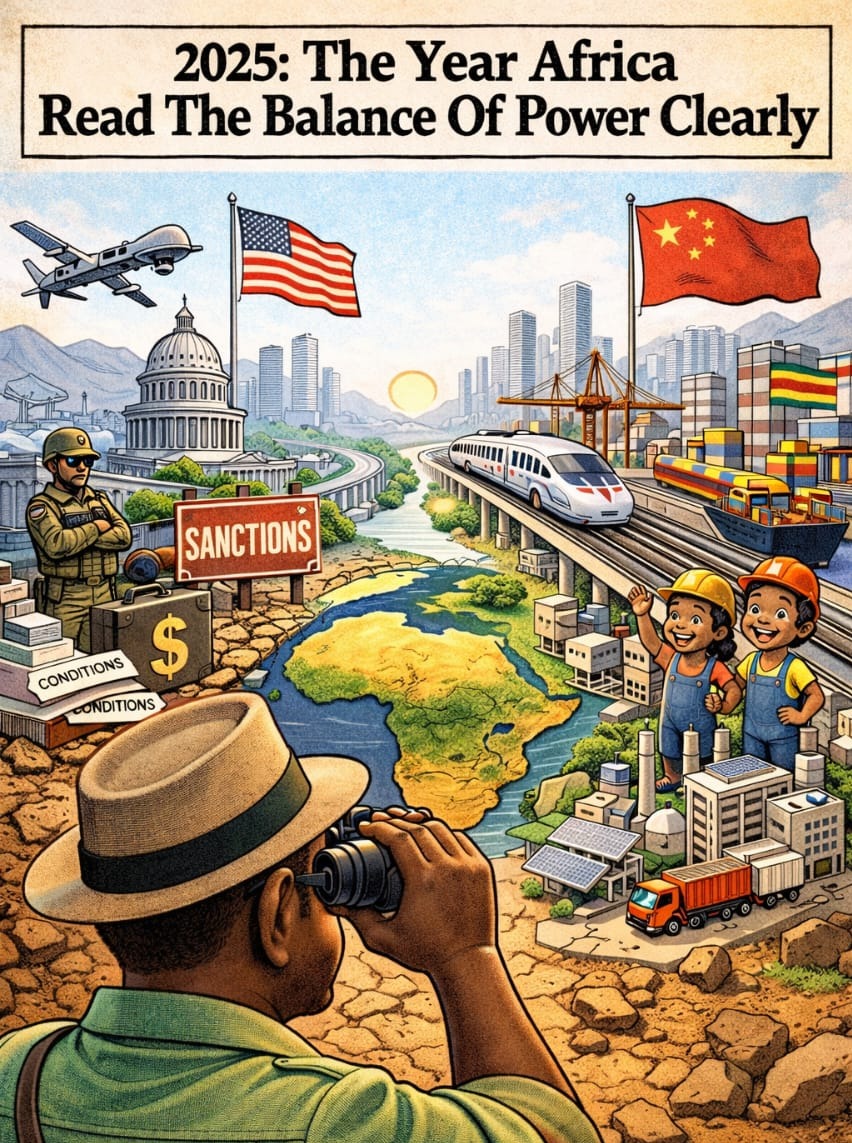
2025: The Year Africa Read the Balance of Power Clearly

As 2025 draws to a close, one conclusion stands with increasing clarity: the global centre of gravity has shifted, not through rupture or spectacle, but through the steady accumulation of deliberate choices made across the Global South. Africa, in particular, has spent this year doing something both quiet and consequential – comparing partners by outcomes rather than promises. In that comparison, the contrast between U.S. and Chinese foreign policy has hardened into a practical judgment about relevance.

This was the year multipolarity ceased to be theoretical. It became operational.

For much of the post-Cold War era, U.S. engagement with Africa rested on a familiar architecture: aid conditionality; security cooperation; values-driven diplomacy. In 2025, that architecture showed unmistakable strain. Policy remained episodic, filtered through domestic political cycles, and increasingly securitised. Engagement was reactive – responding to instability, coups, or geopolitical anxiety – rather than anchored in long-term economic transformation. Trade initiatives lacked scale. Infrastructure financing remained tentative. Sanctions continued to substitute for strategy. More …

Zimbabwe’s 2025 Year-End Audit: Receipts, Not Noise

At the close of 2025, Zimbabweans find themselves at a vantage point that demands a moment of quiet, honest reflection. To truly understand the state of the nation, one must ignore the transient noise of social media and instead look at the receipts – the tangible, measurable evidence of a country in transition. These are not the kind of receipts that fade; they are the kind you can drive on, harvest from, and calculate in the hard language of macroeconomics. This is the year-end audit of a nation that, despite immense external pressure, has chosen the revolutionary act of building over the convenient act of complaining. The story of 2025 is a narrative that holds even when you remove party colors and demand evidence, because the strongest defense of the Second Republic is found in independent corroboration. More …

From Silk to Steel: Sino-Zimbabwean Solidarity

The archaeological silence of the Great Zimbabwe monument has long been broken by a profound discovery: fragments of Chinese porcelain embedded within its ancient stone walls. This ceramic record is not merely a relic of antiquity but a material archive of a sophisticated maritime interchange that predates modern diplomacy by centuries. Today, this historical synergy has evolved into a robust strategic partnership that defines the vanguard of South-South cooperation.

A Civilisational Dialogue

The presence of these artefacts serves as a definitive rebuttal to historical narratives of African isolation. Instead, they position the Great Zimbabwe Empire as a pivotal node in a global network of commerce and culture. Reflecting on this enduring legacy, the Chinese Ambassador to Zimbabwe, Zhou Ding, recently underscored the depth of this connection:

“The discovery of Chinese porcelain at Great Zimbabwe also serves as significant archaeological evidence of deep historical ties between China and Africa. These artefacts highlight Great Zimbabwe’s role as a sophisticated African civilization engaged in long-distance trade and offer a concrete record of the dynamic interactions between China and Zimbabwe centuries ago.” More …